Chemical Knowledge 16:Understanding of PVC flooring products for elevators
Update time: 26-05-07 Views: 280
Understanding of PVC flooring products for elevators
PVC flooring is not a single product, and it can be roughly divided into three categories based on structural differences.
1. Floor covering (low-end coil material)
The raw material of floor covering is primarily recycled PVC, with a high proportion of recycled material fillers. The wear-resistant layer is extremely thin (usually ≤0.1mm), and some even lack a clearly defined wear layer. Plasticizers are mostly phthalates, which release high amounts of volatile organic compounds (VOC) after installation, and the plastic smell is very noticeable in the first few weeks after laying. It has basically no flame retardant properties, and will continue to burn and release toxic black smoke when exposed to fire.
Floor covering is primarily used for temporary rental housing, short-term coverage of warehouses, and DIY simple projects. If floor covering is used in elevator cars, phenomena such as surface scratches, wear and tear of patterns, edge warping, and lingering plastic odor usually occur within a few months. This not only incurs high labor costs and leads to significant customer complaints, but also poses residual fire risks.
2. Multi-layer composite PVC flooring
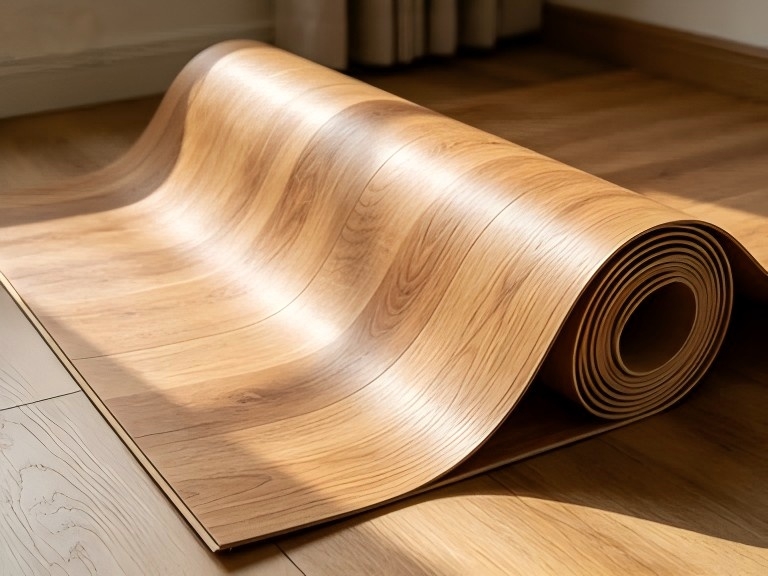
Multi-layer composite PVC flooring is currently the mainstream choice in the elevator decoration market. The structure of multi-layer composite flooring follows a fixed standard, with each layer from the surface to the bottom having its own specific function.
UV Anti-Stain Layer: Factory-applied UV-cured coating, transparent in appearance, seals surface micropores, making stains less likely to penetrate, and simultaneously delays ink fading caused by ultraviolet rays. The UV layer of high-quality products allows for "wax-free" maintenance.
Wear-resistant layer: Pure PVC transparent layer, with its thickness determining the lifespan of the floor. The national standard GB/T 4085-2015 has a clear grading system for the wear-resistant layer: Grade T (FV≤2.0mm³), Grade P (2.0 < FV≤4.0mm³), Grade M (4.0<FV≤7.5mm³), and Grade F (7.5<FV≤15.0mm³). The higher the grade, the better the wear resistance.
Printing layer: It determines the decorative effect of the floor. Ordinary printing adopts offset or flexo printing processes, and is mass-produced in factories using roller printing methods. Large-format customized pattern products adopt high-definition digital printing (UV printer), which can achieve realistic printing of wood grain, stone grain, and carpet grain, and even accept customized pattern printing - customers specify patterns (such as corporate VI colors, specific patterns), and the factory produces them one by one according to the order.
Glass fiber stabilization layer: This is one of the key structures that distinguish multi-layer composite flooring from floor covering. The glass fiber mesh is embedded in the middle layer, limiting the expansion and contraction of the product due to changes in temperature and humidity. The national standard requires a heating dimensional change rate of ≤0.25% (tested at 80℃ for 6 hours). Without this layer of glass fiber, the flooring is prone to bulging and joint cracking under the influence of environmental temperature changes or thermal radiation from elevator transportation.
Compact subbase layer: Provides compressive strength and dimensional stability. A foam bottom or a low-version non-woven fabric can be added to the bottom of this layer to enhance the foot feel, elasticity, and sound insulation effect (noise reduction of about 15-19dB) during use, achieving a better experience.
3. Homogeneous and transparent PVC flooring
The structure of homogeneous and permeable flooring is the simplest and most durable: from the surface to the bottom layer, the material composition is completely consistent, and the pattern and color are "through-bodied" - after the surface is worn, the exposed lower layer still has the same pattern, without the problem of "revealing the bottom".
Due to the absence of a layered structure, homogeneous permeable flooring does not pose a risk of delamination. Its wear resistance can reach M-grade or F-grade (the highest grade for commercial use).
Another characteristic of homogeneous permeable flooring is its strong repairability: surface burn marks or deep scratches can be repaired through local heating (utilizing the glass transition characteristic of PVC, approximately 80-120°C) to activate material fluidity and achieve molecular-level reconstruction and repair. Additionally, the homogeneous permeable flooring is woven with high modulus glass fiber mesh in both warp and weft directions, with a thermal shrinkage rate controlled at 0.06%. In a floor heating environment (55°C), the linear deformation is less than 0.3mm per 3m. The addition of zinc ion slow-release technology allows direct modification of the PVC substrate (not the surface coating), providing extremely high antibacterial properties against pathogenic bacteria, with an effective period synchronized with the material's lifespan. These characteristics make it highly practical in high-traffic scenarios such as high-rise elevators, hospitals, and airports.