Chemical Knowledge 02:PVC Foamed Products - Imbalance Characteristics of Various Additives
Update time: 26-01-09 Views: 284
PVC Foamed Products - Imbalance Characteristics of Various Additives
1. Stabilizers
The most widely used stabilizers in PVC foamed products are lead salt stabilizers and calcium-zinc stabilizers. With the increasingly strict environmental requirements and the higher cost-performance ratio of calcium-zinc stabilizers, the application of calcium-zinc stabilizers has become more and more extensive.
Insufficient stabilizer: Yellowing of the board surface, scorched material, high brittleness of the product, reduced strength, and low foaming rate.
Excessive stabilizer: The foaming agent decomposes in advance, gas overflows from the feeding port and vacuum port, and products with cavity structures may have rib cracks or shrinkage marks
2. External Lubricants
The most commonly used external lubricants in foamed products are generally paraffin wax and PE wax. Paraffin wax is prone to precipitation, so PE wax is usually used.
Insufficient external lubrication: The temperature in zones 4 and 5 of the extruder is difficult to control and prone to overheating; large bubbles, connected bubbles, yellowing appear on the board surface, and the surface of the board is rough; the increased frictional shear heat causes material decomposition, leading to yellowing and scorching of the board surface.
Excessive external lubrication: Poor plasticization leads to scaling in the mold cavity and precipitation on the product surface, which is prone to white streaks, uneven wall thickness, and certain symptoms that move back and forth on the surface irregularly.
3. Internal Lubricants
Common internal lubricants include stearic acid, 60, monoglyceride, 316, etc.
Insufficient internal lubrication: Poor material dispersibility, uneven plasticization, difficulty in controlling the product thickness; the foamed board is thick in the middle and thin on both sides; white streaks, adhesion to the mold cavity, and local overheating may also occur.
Excessive internal lubrication: The foamed product becomes brittle, the heat resistance decreases, and it transforms into external lubrication under a certain temperature and melt pressure, resulting in unbalanced lubrication.
Insufficient both internal and external lubrication: High melt viscosity, large plasticization torque, severe melt wall sticking; yellow decomposition lines appear on the material surface, poor surface smoothness, and reduced mechanical properties of the product.
Excessive both internal and external lubrication: Small plasticization torque, obvious insufficient melt plasticization; although the product has good smoothness, the bonding at the pressure points is poor, which seriously affects the mechanical properties of the product.
Less internal lubrication and more external lubrication: Significantly prolonged plasticization time, reduced plasticization torque, difficult product molding, and brittleness.
More internal lubrication and less external lubrication: Significantly shortened plasticization time, severe wall sticking, shortened thermal stability time, and yellow decomposition lines on the product surface.
4. Calcium Carbonate Powder
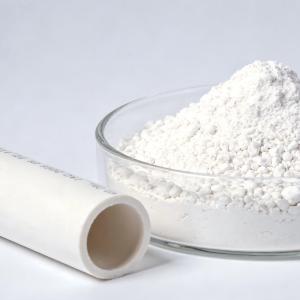
For foamed products, light calcium carbonate with a particle size of about 1200 mesh is preferred. Calcium carbonate powder is prone to moisture absorption, forming bubbles, silver streaks, etc. on the product surface, which affects the appearance and physical properties. Therefore, attention should be paid to storage during the rainy season.
Excessively large particle size of calcium carbonate: Prone to uneven mixing, delayed plasticization time of the mixture, and low screw torque.
Excessively small particle size of calcium carbonate: Prone to agglomeration, turning small particles into large particles, similar to the consequences of excessively large particles.
Insufficient dosage of calcium carbonate: The foam cells lack cores, the number of foam cells decreases, and the foaming rate is reduced.
Excessive dosage of calcium carbonate: The relative content of resin in the composition decreases, the melt strength decreases, and bubble breakage is prone to occur on the cross-section of the board.
5. Foaming Regulators
Foaming regulators generally refer to acrylic processing aids with a viscosity above 10. Among them, wood-plastic foamed products such as ecological wood and wall panels generally use types with fast plasticization, while foamed boards, especially cabinet boards, generally select foaming regulators with slow plasticization and high melt strength.
Insufficient foaming regulator: Poor melt strength, uneven foam cells, foam cells appear on the cross-section, and the density increases.
Excessive foaming regulator: Too high melt strength, bubbles in the melt cannot expand, the product density is high, and the board surface is prone to wavy lines, distortion, etc.
6. Foaming Agents
The most widely used foaming agents are AC yellow foaming agent and NC white foaming agent. AC releases a lot of heat during decomposition, leading to yellowing of the product, and a small amount of ammonia odor is produced during decomposition; NC absorbs heat during decomposition and decomposes without odor. Therefore, the two are generally used in coordination in foamed products.
Insufficient foaming agent dosage: Low foaming ratio, few foam cells in the product, and high density.
Excessive foaming agent dosage: The melt strength will decrease, the product is difficult to form, and foam cells are prone to occur on the cross-section of the foamed board; beyond a certain range, the product density will increase instead.
More yellow foaming agent and less white foaming agent: Large and round foam cells are prone to appear on the cross-section.
Therefore, the dosage of various additives has a certain limit and mutual restriction relationship. Insufficient dosage is not acceptable, and excessive dosage is not necessarily good. In production practice, repeated tests must be carried out to give full play to the coordination effect of various raw materials, find the optimal balance point, fully improve the melt strength and foaming efficiency, and extend the operation time.